P2P investing offers meaningful yield advantages over traditional fixed income. It also carries risks that are distinct from those of public markets and that require an active, disciplined approach to manage.
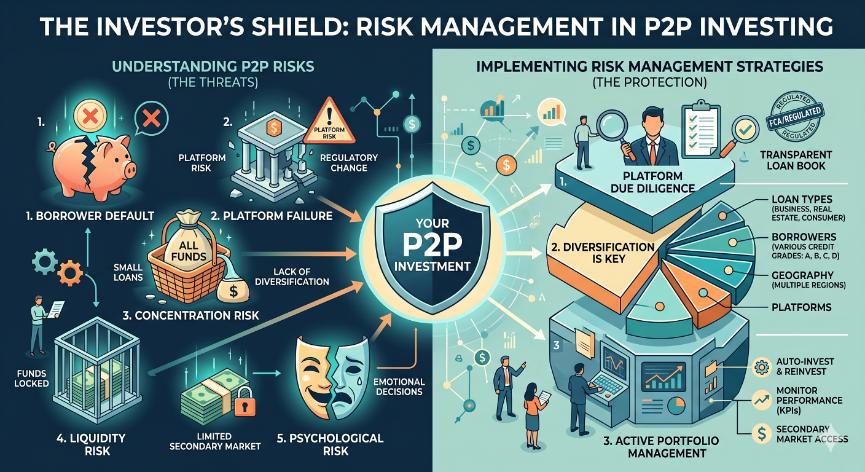
The risk landscape
Understanding P2P risk requires moving beyond the intuitive concern about individual loan defaults. There are four primary categories of risk every P2P investor must account for, and they operate at different levels of the investment structure.
Borrower default risk
The most direct and visible risk is that a borrower fails to repay their loan. This is an expected cost of P2P investing – no platform operates at a zero default rate, and any that claims to should be viewed with scepticism. The question is not whether defaults occur, but whether the platform’s credit selection and diversification mechanisms keep them within manageable bounds.
Net return figures returns after defaults and fees are the correct metric to evaluate, not gross advertised yields. A platform advertising 14% returns with a 5% default rate delivers roughly 9% net; one advertising 10% with a 1% default rate delivers approximately 9% net. The net figures are roughly equivalent, but the risk profile is very different.
Mitigation strategy: Diversify across a minimum of 100 to 200 individual loans. Spreading across 100 or more positions dramatically reduces the impact of any single default on total portfolio performance. Concentrating capital in fewer, higher-yield loans is not a strategy, it is a gamble with expected-value negative outcomes under adverse conditions.
Platform insolvency risk
If the P2P platform itself becomes insolvent, the consequences for investors can be severe even if their underlying loans are performing. Operations may be suspended, secondary market access may be lost, loan management and servicing may break down, and recovery timelines can extend to years.
Well-structured platforms hold client funds in segregated accounts separate from the platform’s own operating capital. This is an important structural protection: platform insolvency should not, in principle, result in investor funds being used to meet platform debts. Verify that any platform you invest through operates with segregated client money, and confirm this in their terms and regulatory filings.
Always ask: what happens to your loans if this platform closes tomorrow? The answer and whether the platform has a credible wind-down plan, tells you a great deal about its operational maturity.
Loan originator risk
On multi-originator platforms, the insolvency of a loan originator creates a distinct and serious problem. When Eurocent collapsed on Mintos in 2017, investors lost access to hundreds of thousands of euros because the originator, not the loans had failed. Since then, the sector has improved originator transparency considerably, but the risk remains.
Treat each loan originator as a separate exposure concentration. Do not allow any single originator to represent more than 10% to 15% of your total P2P portfolio. Review originator financial statements annually. If an originator begins experiencing delayed payments or financial stress, even minor and temporary, take it seriously and reassess exposure promptly.
Liquidity risk
P2P investments are fundamentally illiquid. Unlike publicly traded securities, you cannot exit a loan portfolio in minutes. Secondary market functionality exists on some platforms, but it is demand-dependent and during periods of market stress, when many investors try to sell simultaneously, secondary market liquidity can evaporate precisely when it is most needed.
The appropriate response is not to avoid P2P investing but to size your P2P allocation in relation to your overall liquidity needs. Capital you may need within 12 to 24 months should not be deployed in P2P. Consider P2P as part of a long-term capital allocation that you are comfortable holding to loan maturity if secondary market access becomes unavailable.
Systemic and macroeconomic risk
Credit default rates across all loan types increase during economic downturns. A portfolio performing well in normal conditions can experience materially higher defaults and loan originator stress during a recession. This is not unique to P2P. All credit carries cyclical risk but it is amplified in P2P by the liquidity constraints discussed above.
Stress-test your portfolio against a scenario where defaults rise 3 to 5 percentage points above platform averages and secondary market access closes for 12 months. If the resulting net return is still acceptable or the capital loss is within your risk tolerance, your allocation is appropriately sized. If not, reduce it.
Structural protections to seek out
Not all risk can be eliminated, but well-structured investments carry meaningfully lower downside. When evaluating specific loans or platforms, prioritise these protections:
- Secured loans: Property-backed or asset-secured loans provide recovery value in default scenarios. An unsecured personal loan in default has little recovery; a first-charge mortgage loan can often recover substantial capital through property sale.
- Low loan-to-value ratios: For real estate lending, LTV below 70% provides a meaningful buffer against property value declines before investor capital is impaired.
- Diversification across loan types, geographies, and platforms: Concentration in any single dimension – one platform, one originator, one country, one loan type – amplifies correlated risk.
- Skin in the game: Originators retaining 5–15% of loans they issue have aligned incentives to maintain underwriting quality.
Discuss this article / 0 comments